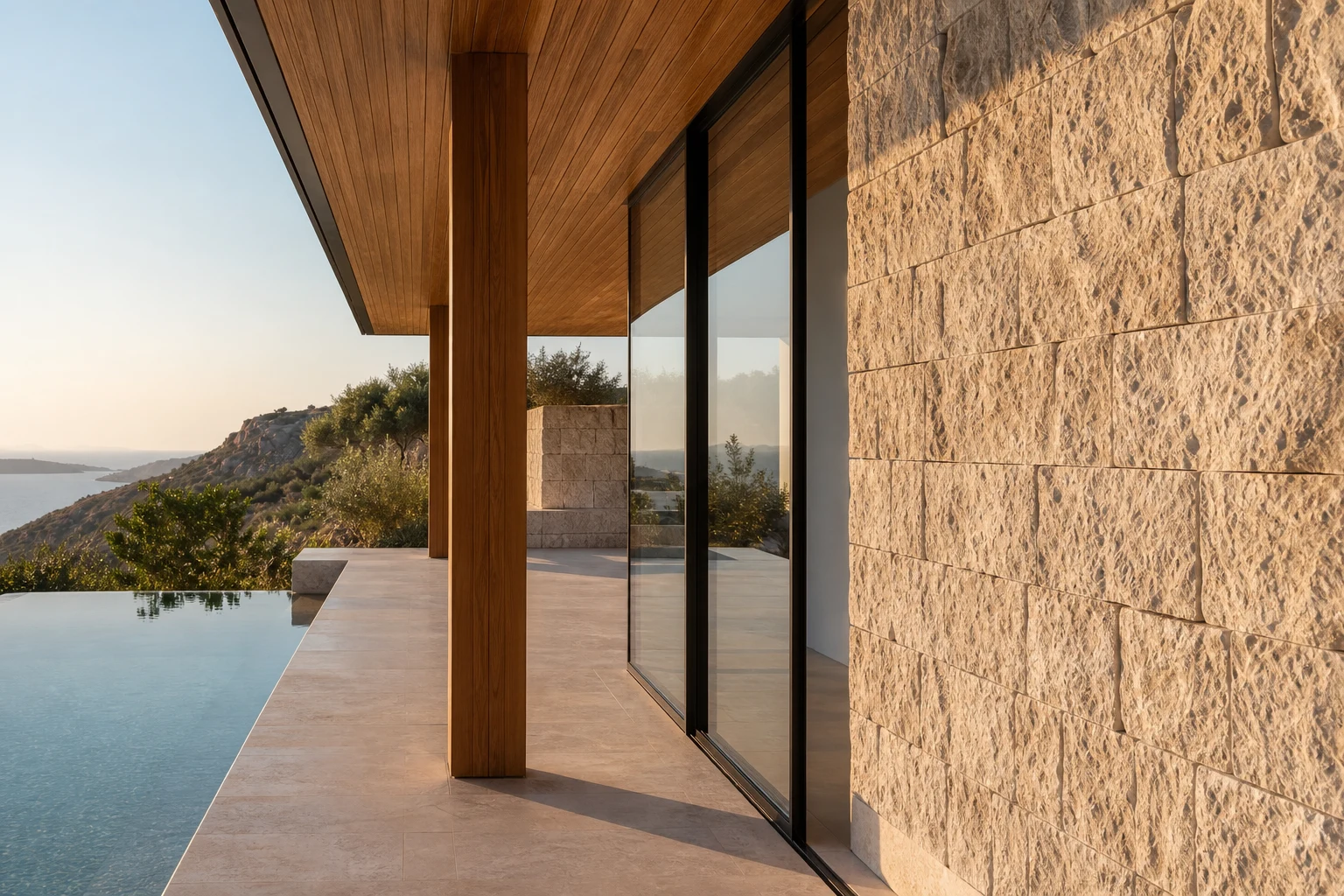
A guide to choosing stone, metal, timber, windows, coatings, waterproofing and landscape materials for salt, UV, humidity and wind on the Aegean coast.
On the coast, material selection is a performance decision before it is a colour or texture decision. Airborne salt, intense UV, humidity, thermal movement, strong wind and seasonal vacancy affect everything from metal fixings and timber cladding to window gaskets and stone joints. A material that ages well is not one that never changes; it is one whose change is understood, whose maintenance is accessible and whose failure does not damage adjoining systems.
The invisible path of salt
Salt does not reach only the sea-facing elevation. Wind carries it under eaves, into ventilation grilles, door tracks and fixing cavities. Because it attracts moisture, it accelerates corrosion cycles. Material grade matters, but so do fixing geometry, drainage, separation of dissimilar metals and access for cleaning.
Stainless steel: grades are not equal
“Stainless” is not a complete coastal specification. Exposure, finish, post-weld treatment and fixing grade must be considered together. An unsuitable screw can initiate local staining even in a high-grade balustrade. Concealed fixings should remain inspectable and the fabricator should provide coastal maintenance guidance.
Aluminium windows and coatings
For aluminium, alloy, pretreatment, coating system, film thickness and treatment of cut edges all matter. Salt and sand can block drainage tracks; large sliding doors need routine cleaning of rollers, gaskets and locks. In exposed zones, warranty conditions, cleaning intervals and approved maintenance products should be documented at handover.
Timber: natural silvering or coating system?
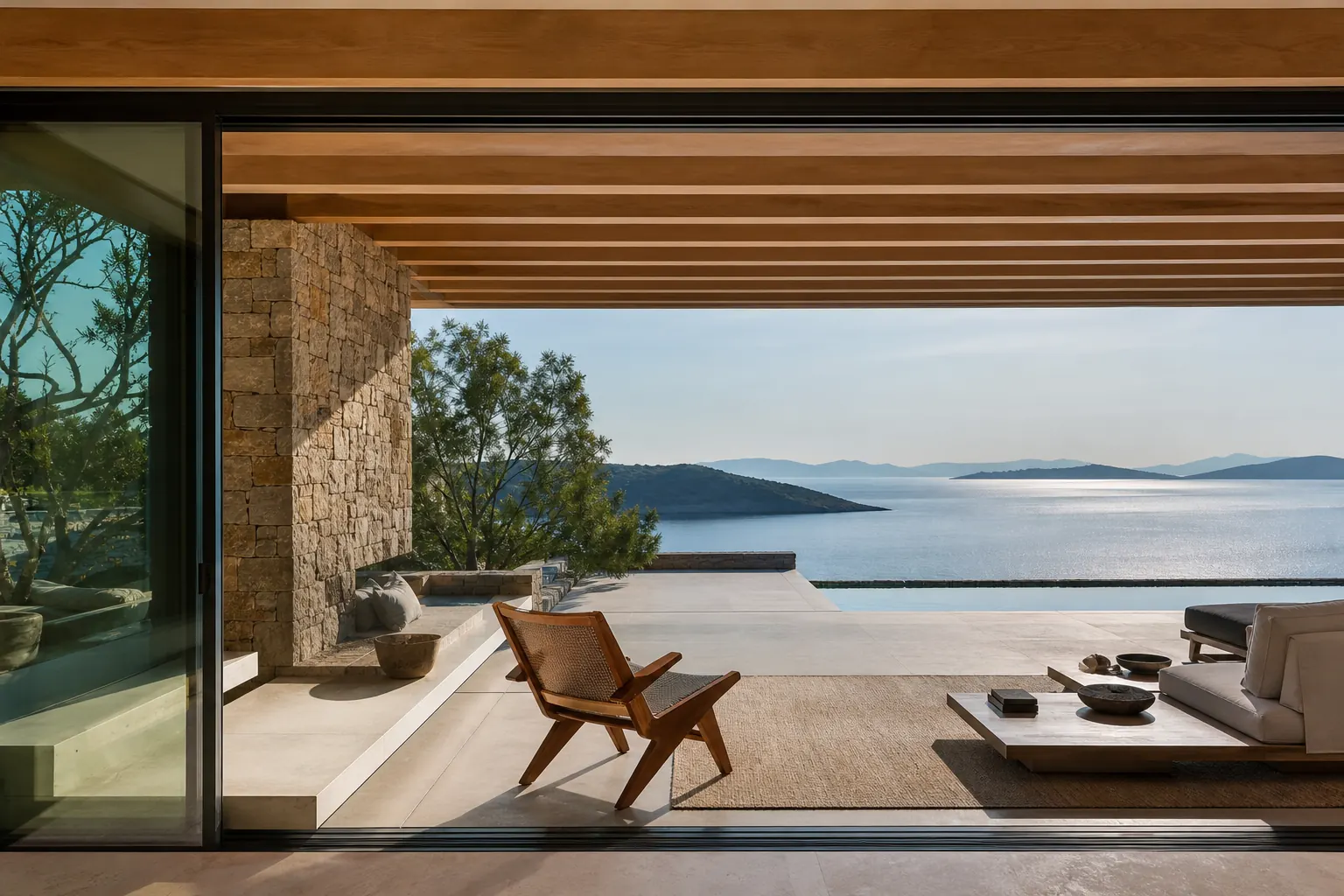
Coastal timber needs one of two clear strategies. The first accepts natural silvering with a suitable species and detail; the second preserves colour through a regular coating regime. An undefined middle ground produces uneven ageing between sun and shade. Rear ventilation, end-grain protection, ground clearance and replaceable small components matter as much as species.
Natural stone and joints
Coastal suitability of stone is not defined by strength alone. Water absorption, salt crystallisation, wet-dry cycling, slip and staining should be tested. Pool surrounds face a different combination of chemicals and salts. A poor joint or trapped water can cause staining and surface loss even in durable stone. An external mock-up should precede bulk purchase.
Render, paint and mineral finishes
Dark surfaces absorb more heat and move more under strong sun. Flexibility, vapour permeability, primer compatibility and water management must be considered together. “Exterior paint” is not a sufficient specification for a salt-exposed elevation. Crack bridging, alkali resistance, UV performance and recoating procedure should be defined.
Waterproofing and drainage: the most expensive invisible layer
Problems in terraces, pools, planters and retaining walls often arise not from the membrane itself but from outlets, upstands, movement joints, thresholds and trade sequence. Flood testing, photographic records and independent inspection should precede covering. A concealed gutter or narrow drain that cannot be maintained may require major demolition a few years later.
- Salt cleaning and corrosion inspection at metals and fixings
- Window track, gasket, drain and lock maintenance
- Roof, terrace, outlet and overflow inspection
- Façade crack and joint review
- Timber cleaning or recoating according to strategy
- Stone surface, pool chemistry and slip review
- External plant and grille cleaning
- Operable-element checks before and after storm season
There is no maintenance-free material; there are buildings whose maintenance was never designed.
Choosing through life-cycle cost
Comparing only purchase prices is incomplete. Substrate preparation, warranty conditions, cleaning frequency, recoating, spare-part availability, access and potential replacement cost should be evaluated together. On coastal projects, Pera Villas. builds the palette around exposure zones and maintenance capacity as well as visual coherence, then provides a building maintenance passport with product references and intervals.